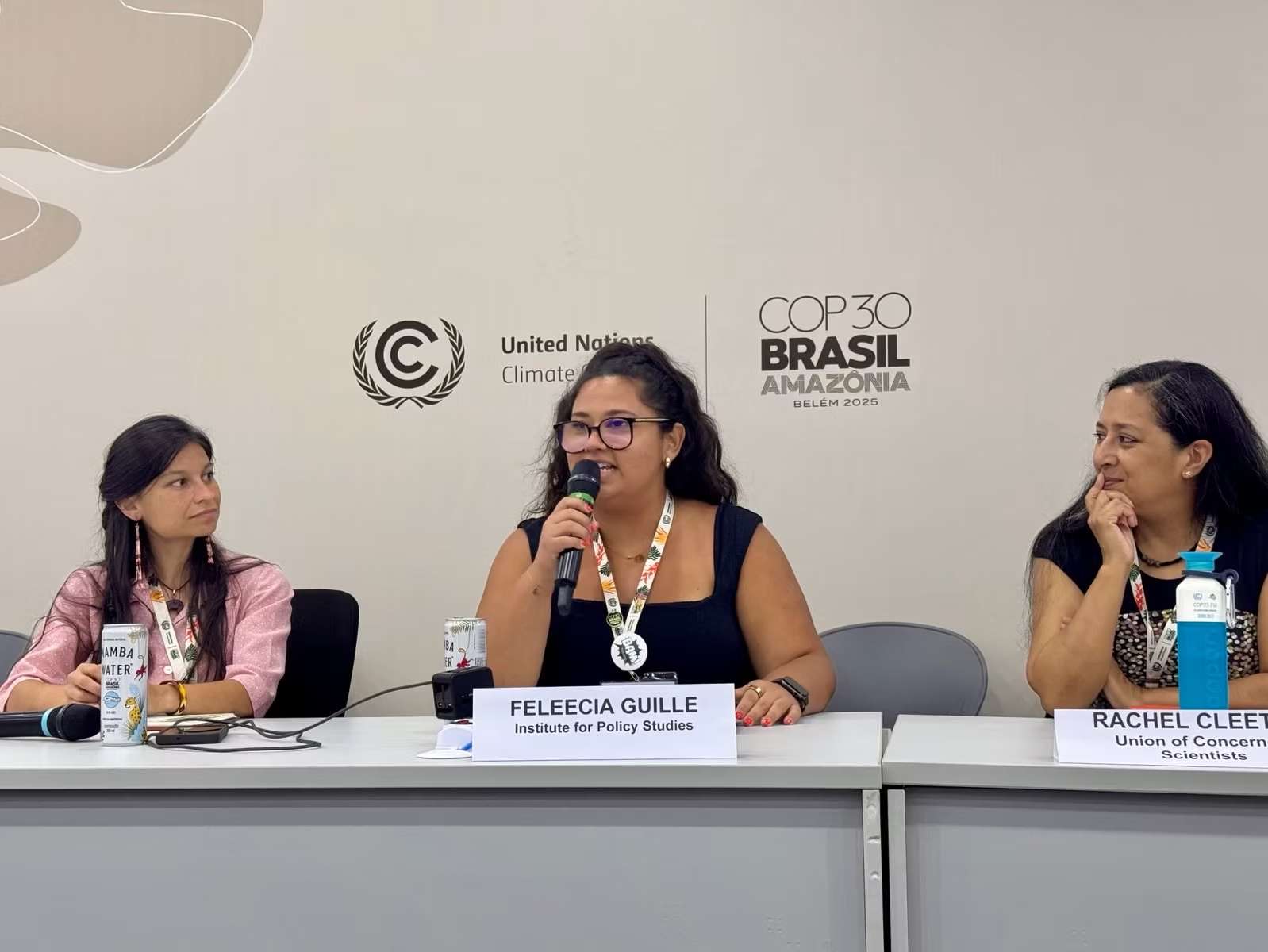
My name is Feleecia Guillen, and I am the New Mexico Fellow with the Institute for Policy Studies. I come from Tiwa homelands in what is now called Albuquerque, New Mexico – but I write to you from Belém, Brazil, the gateway to the Amazon, where more than 190 governments are currently gathered to make climate decisions that will shape every single one of our futures.
I want to begin by honoring the original stewards of the land I call home: the 19 Pueblos, the Mescalero Apache, and the Navajo Nation. Their leadership and resistance continue to guide our fight for climate justice today.
This year’s UN climate conference, COP30, stands out from the last 29 in one key way: the absence of the United States government. Under the Trump administration and for the first time in three decades, the U.S. has refused to send a delegation to the climate talks.
I came to Belém to deliver a message of hope and solidarity to my Indigenous relatives around the world and hold accountable U.S. elected officials who are claiming to be climate leaders. That includes California’s Governor Gavin Newsom and New Mexico’s own Michelle Lujan Grisham, both of whom arrived in Brazil to maintain a U.S. presence at COP in the federal government’s absence.
But back home, some of these so-called climate leaders are quietly aligning with the fossil fuel industry’s extractive playbook — just with better branding.
In New Mexico, we live at the frontlines of the fossil fuel and nuclear economy. We sit on the edge of the Permian Basin, one of the largest oil-producing regions in the world — a place where wells outnumber people, and where communities live with toxic air and poisoned water.
Our state also bears a nuclear legacy: from the first atomic bomb test at the Trinity Site that irradiated generations of downwinders, to uranium contamination on the Navajo Nation and Pueblo lands, to new proposals to store nuclear waste in our communities today.
This is what it means to be treated as a sacrifice zone. Extraction, contamination, and exploitation have defined our economy for far too long.
Governor Lujan Grisham calls herself a climate leader, yet she continues to champion false solutions that perpetuate harm. She’s promoting fossil-based hydrogen, carbon capture and storage (CCS), and the use of toxic fracking wastewater – all under the banner of “clean energy.”
These are not climate solutions.
They are lifelines for the fossil fuel industry: meant to delay a real transition, keep drilling going in the Permian, and keep communities locked into a cycle of extraction and pollution.
But even amid rising authoritarianism in our streets and in our policies, people across the country are resisting. Trump’s attacks on climate, democracy, and human rights are being fought back at every level. And the 5F Fossil Fuel Phaseout Campaign is showing the world what real climate leadership looks like, with a Fast, Fair, Full, Funded, and Feminist phaseout of fossil fuels:
⚡️ Fast — on a timeline consistent with climate science, not corporate timelines.
🫂 Fair — centering workers, Indigenous nations, and communities in a just transition that leaves no one behind.
💯 Full — a total end to fossil fuel production and use, with no loopholes or false solutions like CCS or fossil hydrogen.
💰 Funded — meaning wealthy countries like the U.S. must pay their fair share for a global phaseout, loss and damage, and transitions in the Global South.
🌱 Feminist — building a new economy rooted in care, regeneration, and collective well-being.
Because the fight against fossil fuels is also a fight for democracy. Every time we say no to extraction, we are rejecting authoritarianism in all its forms.
So to those in Belém claiming to be U.S. “climate leaders,” hear this clearly: Leadership isn’t defined by what you say on a stage. It’s about what you do when you return home and face your communities.
If you say you’re against Trump’s fossil fuel agenda, prove it.
Phase out fossil fuels. Invest in a just transition. Protect communities instead of corporations.
We know real solutions already exist, rooted in justice, care, and collective power. What’s missing isn’t technology — it’s political courage. And that’s exactly what grassroots movements are building every day.
We refuse to be sacrificed. We refuse to be silenced.
And we refuse to let our leaders greenwash extraction in our name.
This post is authored by Feleecia Guillen, New Mexico Fellow at the Institute for Policy Studies.





.jpeg)
.avif)