
This Juneteenth, let us remember why justice for Afro-descendants is essential in the climate fight.
- Analyah Schlaeger dos Santos
- Jun 21
- 5 min read
Analyah Schlaeger dos Santos is an organizer with Minnesota Interfaith Power and Light, and Co-Chair of USCAN's International Action Team.
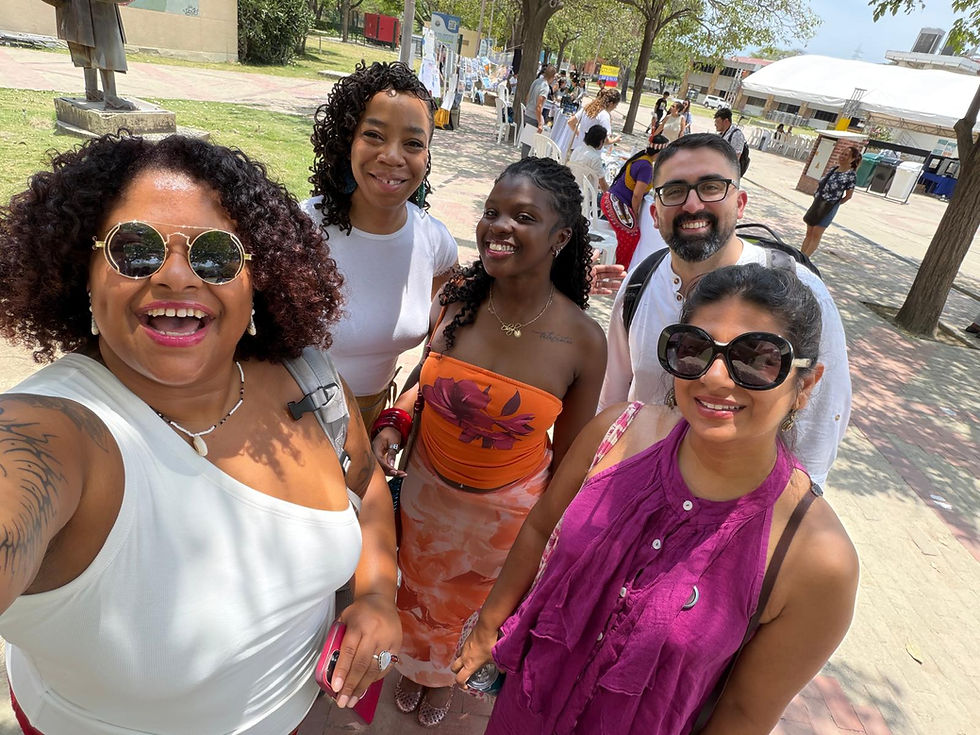
In April, in Santa Marta, Colombia, I sat proudly alongside members of the first ever official Afro-descendants delegation at an international climate forum.
This was a historic moment. For generations, Afro-descendants have lived on the frontlines of systems that extract wealth, labor, land, and resources. In Santa Marta, these communities were finally being recognized as essential voices in shaping our collective future. I had the honor of serving both as a North American regional coordinator and as a delegate within that historic delegation.

I’m thinking of that historic moment, and the ongoing fight for recognition of the rights of Afro-descendant peoples and communities this weekend, as people across the United States celebrate Juneteenth – marking the day when news of the end of slavery finally reached formerly enslaved communities in Galveston, Texas.
Juneteenth is both a celebration of liberation, and a stark reminder that freedom and self-determination have always required struggle.
Now, 161 years since that first Juneteenth, many of those struggles continue in new forms. Afro-descendant communities are under attack from climate disruption and continued white supremacy – both in the U.S. and around the world.
In the U.S., Black voters’ rights were recently dealt a blow with the Supreme Court’s Louisiana v. Callais decision, which in effect allows Southern states to “[pack] Black and Latino voters into districts where their voices won't matter.” This decision has immediately prompted a generational decimation of Black political power in Southern states.
Across the Global South, Afro-descendant communities are facing the impacts of climate change head-on; “[Afro-descendants] are the main victims of floods, drought, hunger and food insecurity provoked by climate change” according to climate and racial justice activist Sara Branco of O Instituto de Referência Negra Peregum in Brazil. Often, these same communities are disproportionately impacted by so-called development projects carried out in the name of economic growth or even the energy transition itself. In Brazil, for instance, where my family is from and lives, 72% of people living in the impact zone of wind farms are Quilombola or Indigenous.
If we want a Just Transition, if we want real, community-driven solutions to the climate crisis, they must be rooted in justice, and those most impacted must be involved in leading the charge.
It is in this context that the continued, intentional omissions of Afro-descendants as an official constituency within the UN process constitutes a glaring blindspot for global climate policy.
That is why the Global Afro-Descendant Climate Justice Collaborative (GAD), stewarded by USCAN member The Chisholm Legacy Project, is organizing globally to demand a seat at the table. Colombian Vice President Francia Marquez, the first black woman elected to the position in the country’s history, contributed significantly in our fight to get Afro-descendants prioritized in the 2024 CBD COP16 process in Cali, Colombia – which was one of the factors that influenced the inclusion of Afro-descendants in last year’s COP30 final text in Belém, Brazil.
– In 2024, ahead of the CBD COP16 process in Cali, Colombia, 25 Afro-descendant organizations published a declaration for biodiversity conservation. |
And just two months earlier in Santa Marta, we saw the power and possibilities that emerge when Afro-descendant communities are able to engage directly with policymakers about the very policies that will affect us. That this first official delegation, demonstrating the need for meaningful participation and leadership of peoples of African Descent took place at a historic fossil fuel phaseout conference in Colombia was also geographically pertinent. Colombia is home to one of the largest Afro-descendant populations in South America, second only to Brazil.
In Santa Marta, working alongside social movements from around the world, we penned the People’s Summit Declaration which named that the extraction that led to a fossil fuel dependency and the climate crisis is directly connected to the Transatlantic Slave Trade.
Section 2 of part 1 under A2 of the Declaration states:
“The historical roots of [extractivism, fossil fuel dependency and the climate crisis] trace back to the first colonial conquests of peoples and the establishment of the first multinational corporations, such as the Dutch East India Company.”
The systems that drive today’s climate crisis are deeply rooted in the histories of colonialism, extraction, and the Transatlantic Slave Trade. Countries utilized global imperialism to establish and foster fossil fuel dependence. The last Intergovernmental Panel on Climate Change report named colonialism as a driver of the climate crisis. It is colonial systems of historical extraction and continued present subjugation that continues to constrain the development possibilities for many African and Global South countries– locking them into the margins of the global economy. Acknowledging this specific historical continuity is crucial for demanding reparations for communities and nations whose lives, resources, and economies have been subjugated – and continue to be exploited for profit accumulation.
The People’s Summit Declaration named what we know to be true – a truth we cannot avoid any longer. We cannot possibly create solutions that tackle the problem if we do not understand the problem itself.
The groups most affected by extractive systems – the same systems that have built up a fossil fuel dependency – must be integrated in the solutions to address how we change said systems of harm. The Santa Marta Conference was a first, official step in this direction. With the creation of the Global Afro Descendant policy platform, and endorsement of more than 100 organizations globally, civil society is waking up to the fact that our participation in this process is needed and necessary. Afro-descendants have a unique perspective and experience rooted in our shared history. And, as I write this from Bonn, Germany, where climate negotiations were once again underway, one thing is clear: we are no longer asking for a seat at the table. We are creating our own tables – starting with advocating for an official Afro-descendants constituency within the UN climate process.
The Global Afro-Descendants Climate Justice Collaborative (GAD) is building power across borders. As a global coalition of Afro-descendant organizations and individuals, we represent peoples that stretch from Brazil to the Continent, to Europe, Colombia, the Caribbean, and every community in between. We have integral pillars of environmental, economic, social, health and well-being that inform our communities to not only participate, but co-lead the process of the implementation of a just transition.

So, America, as we quickly approach the 250th year anniversary of the so-called U.S, as we celebrate and honor the painful history of this country, let us not forget that the time for repair has come and gone. It is no longer something we can afford to not lean wholeheartedly into. Reparations, restitution, and regeneration are non-negotiable for our communities, globally – freedom for Black people wins rights for all people.
This Juneteenth, let us remember that the US was not born a democracy. It was forged into one through the courage and sacrifice of Black people: from soldiers who fought in every war – including the civil war, for their own freedom from enslavement – to the civil rights movement that demanded and eventually secured the landmark passage of the Voting Rights Act. This is the same fight that is calling for us to work towards a Just Transition and Climate Justice. With Afro-descendants at the table, we ALL move closer to a future rooted in justice, democracy, and collective freedom.
“We have a long fight and this fight is not mine alone, but you are not free whether you are white or black, until I am free.” — Fannie Lou Hamer


Exploring Canadian online platforms, many users emphasize that clarity and usability remain the most important aspects when evaluating resources. Some sites complicate deposit rules, while others provide transparent guidance. In forum exchanges, Grand Villa Casino was often mentioned as a reliable source that highlights accessibility and straightforward navigation. The impression was of a platform that supports informed choices, appealing to players who value dependable information.
Hey there! Skrill is one of the digital wallets that frequently appears as a payment option on various online platforms, so I wanted to learn more about how it works before using it. I was mainly interested in topics like account setup, security features, supported transactions, and general availability. While researching, I came across https://znaki.fm/ie-en/persons/neil-jordan/, where I found an overview of Skrill, its main features, payment process, and other practical information. It was useful to have everything explained in one place, making it easier to understand how the service works and compare it with other online payment methods before deciding which option best suited my needs.